While providing AEO services, we needed constant verification of ChatGPT output to actually know whether our actions were helping clients appear in results for desired queries or not. Such checks had to be comprehensive (mass-scale) and independent. Therefore, we used the OpenAI API, as well as a system that mimicked human behavior, and manual anonymous sessions. And in the course of this, we began to notice that the verification method affected the results.
So we had a question: Can we trust that ChatGPT will give the same answer regardless of where you use it? Our team decided to test this hypothesis in practice, so as not to make empty claims. We conducted systematic testing of ChatGPT output through the web interface, API, and mobile application. Spoiler alert — we were right and confirmed our hypothesis.
The hypothesis we put forward was:
To obtain objective results, we formulated and documented a verification methodology:
Test queries: 10 geo-independent questions (to exclude the influence of user location)
Platforms for testing:
Important detail: the standard Temperature value is 0.7, so we tested with lower (0.4), standard (0.7), and higher (1.0) values for the API.
Testing conditions: all checks were conducted in separate new chats for experimental purity.
All the results obtained were recorded in the table: Is the ChatGPT issuance different in the web version, via API and in the application?
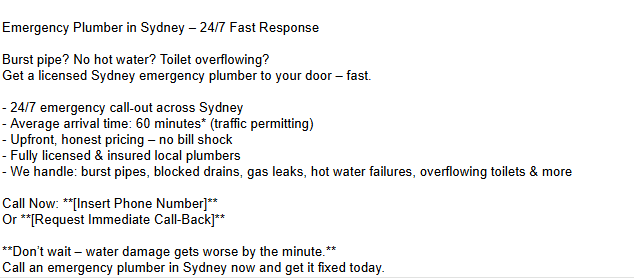
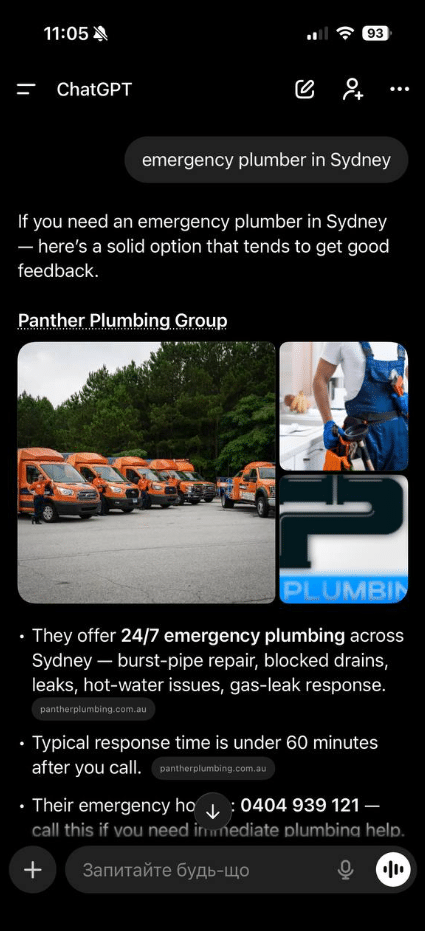
Example breakdown of one query: “emergency plumber in Sydney”
Web incognito:

API temperature 0.7:
App account:
After analyzing all obtained data, we reached several important conclusions:
Output through API differs most significantly from other platforms. Responses have a different format, structure, and sometimes even content.
Key API differences:
In most cases, responses in the ChatGPT web version and mobile application are very similar to each other. This is logical, since both interfaces are oriented toward the average user and conversational communication format.
What unites the web version and app (chat.openai.com):
Through API, we did not detect significant differences when changing the Temperature parameter (0.4, 0.7, 1.0).
Why did this happen?
The Temperature parameter primarily affects creativity and variability in repeated queries, not the structure or format of one-time responses. That is, if you ask the same question several times, Temperature determines how different the answers will be. But it has minimal impact on the quality and completeness of the first response.
In order to better understand the reasons for the differences, we also analyzed the explanations of the model itself. Here are the key factors that influence the difference in output:
| Factor | Explanation |
| System instructions | Web/app are oriented toward dialogue and user convenience. API receives minimal instructions, you define the rules yourself. |
| Dialogue context | The web version has history, style memory, and prompts. In API there is no automatic memory and each request is isolated unless you pass context manually. |
| Generation settings | In API you control parameters (temperature, top_p, max_tokens). In the web version these settings are hidden and dynamic. |
| Additional layers | Web version has filtering, safety layers, and reformulation. API responds more straightforwardly. |
| Model versions | The web version may use optimized versions. In API you call a specific model. |
API and regular user queries in ChatGPT from the app or web version are NOT the same thing.
If responses through API seem less quality, the problem is often not in the model, but in the settings: weak system prompt, absence of roles or examples, non-optimal generation parameters.
Our research confirmed that ChatGPT output indeed differs when using API, which is quite natural given its purpose and flexibility of settings.
The web version and mobile application show high consistency of results, making them interchangeable for most user scenarios.
The main thing is to understand that each platform is created for its own purposes, and the right choice depends on your specific needs. API — for developers and integrations, web and app — for direct communication with AI. And if you’re taking quality actions to increase citation of your site in ChatGPT, then checking work results through API is not advisable, although of course it’s simpler and very tempting.

CONTACTS
Promotion application: order@luxeo.team
For partnership: partner@luxeo.com.ua

Thanks for your application!
Our specialists will contact you within 24 hours