ChatGPT, Google AI Overview, and other AI assistants already process millions of queries daily, offering ready-made answers instead of the list of pages that regular Google search provides. For SEO professionals, this means the emergence of a new obvious challenge: for effective client promotion, it’s not enough to simply reach Google’s TOP rankings — you need to find out whether users will see their site in AI responses.
But is it necessary to be in the TOP rankings for this, or do rankings not affect it at all? Do LLM systems use traditional search rankings as the basis for their recommendations? If so — to what extent? Understanding these mechanisms is critically important for adapting SEO promotion strategies (and marketing in general) in the new era of AI search. So, faced with these questions, we began looking for answers.
We put forward two key hypotheses based on our own observations and opinions:
Hypothesis 1: A site’s appearance in ChatGPT output depends on its position in Google and Bing’s organic search results. Sites in the TOP-30 have a significantly higher probability of being mentioned in AI responses.
Hypothesis 2: Google AI Overview has an even stronger dependency on its own organic search results since it’s a product of Google’s ecosystem, and the algorithm most likely prioritizes its own top results.
Additional assumption: The dependency may vary depending on query type (local vs. general), language (Ukrainian vs. English), and account type (logged in vs. incognito), which influenced our query selection for testing.
To ensure maximum objectivity, we immediately describe the conditions we set for ourselves.
Using VPN allowed us to avoid the influence of personalization based on geolocation and obtain “clean” search results that a typical user from Ukraine and the US would see. We’ve already described the impact of GEO on ChatGPT results, as we tested this hypothesis first.
Logged-in accounts allow tracking the influence of search history and personalization, while incognito mode shows basic results without considering user context.
The selection of 20 queries provided a sufficient statistical base for identifying patterns, covering various intent types: informational, commercial, local, and navigational.
| Where? | Ukrainian Queries | English Queries |
|---|---|---|
| Послуги SEO просування | SEO promotion services | |
| ChatGPT | Компанії з послуг SEO просування | Give me a list of companies providing SEO promotion services |
| кафе неподалік | cafe nearby | |
| ChatGPT | в яке кафе неподалік мені піти | which cafe nearby should I go to? |
| Автосалон | Car showroom | |
| ChatGPT | Напиши список із 10 автосалонів | Write a list of 10 car dealerships |
| Купити Біткоін | buy btc | |
| ChatGPT | Де купити біткоін | where to buy btc |
| доставка їжі | food delivery | |
| ChatGPT | де замовити доставку їжі | where to order food delivery |
| додаток для психічного здоров’я | mental health app | |
| ChatGPT | додаток для психічного здоров’я | mental health app |
| платформа онлайн-навчання | online learning platform | |
| ChatGPT | платформа онлайн-навчання | online learning platform |
| SEO-агентства в Україні | seo agencies in California | |
| ChatGPT | SEO-агентства в Україні | seo agencies in California |
| криптогаманці для початківців | crypto wallets for beginners | |
| ChatGPT | криптогаманці для початківців | crypto wallets for beginners |
| платформа для потокового передавання музики | music streaming platform | |
| ChatGPT | платформа для потокового передавання музики | music streaming platform |
Data collection occurred in several sequential stages, each requiring result recording. The process was completely standardized for all 20 queries, ensuring data comparability. Using automated tools to collect TOP-100 results avoided human error and missed positions. Our action plan was as follows:
All data was compiled into structured tables for statistical analysis.
Ukrainian Results:
This indicates strong dependency on TOP-10–30 for topics with clear recommendations, but independence for local queries.
English Results:
The absence of AI Overview in some queries (food delivery, SEO agencies) lowers average dependency. This suggests AI Overview is effective for structured topics but weaker for local queries due to generalization.
Key feature: AI Overview selectively chooses authoritative sources (binance.com, promodo.com, coursera.org, wikipedia.org), ignoring 60–70% of sites from TOP-30. For categorical queries, dependency is higher; for local queries — low or absent due to answer generalization.
Ukrainian Results:
ChatGPT relies more on internal knowledge, generating lists of companies/services without strong attachment to current search results. Logged-in accounts more frequently localize responses (Dnipro/Ukraine), with higher matches than incognito.
English Results:
General trends: Dependency is higher for general topics (SEO, crypto), where GPT/AI use popular sources. For local queries (cafes, delivery) — lower, due to personalization of responses without directly copying Google’s TOP. Average probability of appearing in TOP-30: ~60% for AI, ~50% for GPT. Recommendations: For accuracy, specify location in tests; aggregation shows GPT is less dependent on Google than AI.
| Position Group | Google Positions | Average Probability for AI Overview | Average Probability for GPT |
|---|---|---|---|
| 1 | 1–10 | 30% (0.3) | 16% (0.16) |
| 2 | 11–20 | 4% (0.04) | 2% (0.02) |
| 3 | 21–30 | 6% (0.06) | 2% (0.02) |
| 4 | 31–40 | 0% (0.0) | 2% (0.02) |
| 5 | 41–50 | 4% (0.04) | 0% (0.0) |
| 6 | 51–60 | 0% (0.0) | 0% (0.0) |
| 7 | 61–70 | 0% (0.0) | 0% (0.0) |
| 8 | 71–80 | 0% (0.0) | 0% (0.0) |
| 9 | 81–90 | 0% (0.0) | 0% (0.0) |
| 10 | 91–100 | 0% (0.0) | 0% (0.0) |
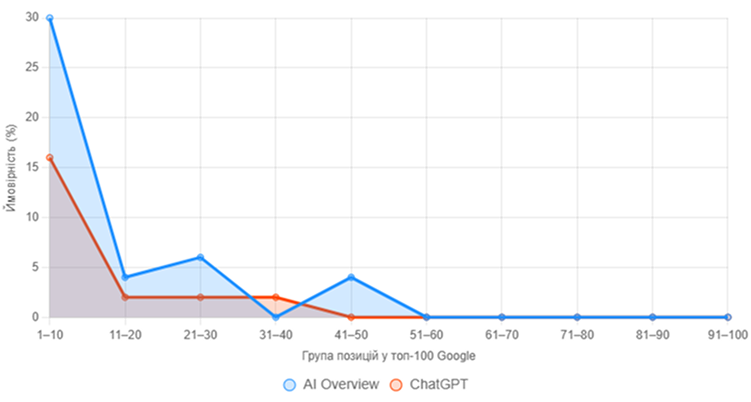
Probability of URL getting into AI Overview and ChatGPT (Ukrainian edition)
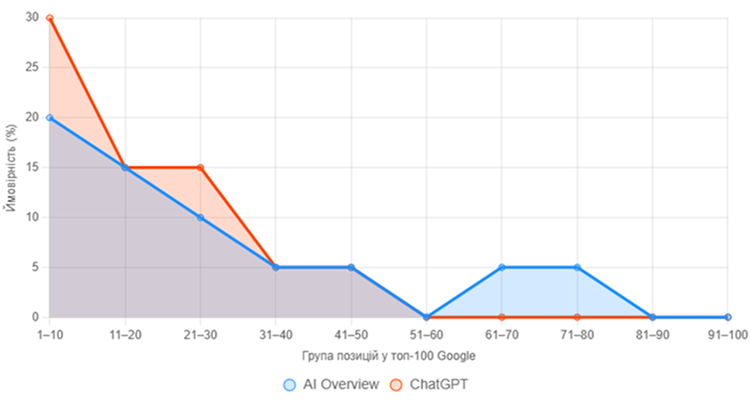
Probability of URL getting into AI Overview and ChatGPT (English edition)
Based on query analysis, the following generalized conclusions can be drawn regarding the dependency between Bing search results and GPT citations:
Strong correlation with Bing TOP-10:
This confirms that GPT (likely through RAG mechanics) actively uses top Bing search results, especially review articles (e.g., pcmag.com, forbes.com, clutch.co).
Sharp decline after TOP-10:
This indicates GPT’s clear focus on high-ranking sources, although additional sources from lower positions (e.g., wikipedia.org, theverge.com) may appear through web_search or contextual relevance.
Account type impact:
Citation probability:
Influence factors:
Differences by topic:
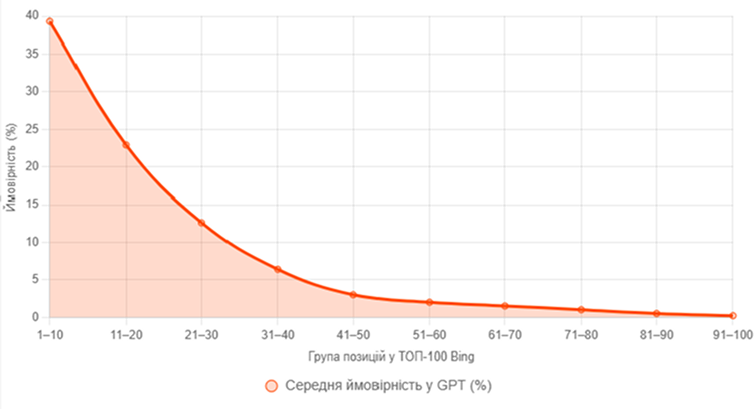
Probability of a URL getting into ChatGPT by Bing positions
GPT demonstrates clear dependency on Bing TOP-10 results, especially for review and ranking sources. Logged-in responses are more oriented toward authoritative sources, while incognito mode expands coverage to less popular but relevant sites through web_search. Citation probability depends on Bing position, but exceptions (wikipedia, youtube) have stable influence. Query topics and localization affect source selection, but the general trend is priority for top, structured reviews from the US.
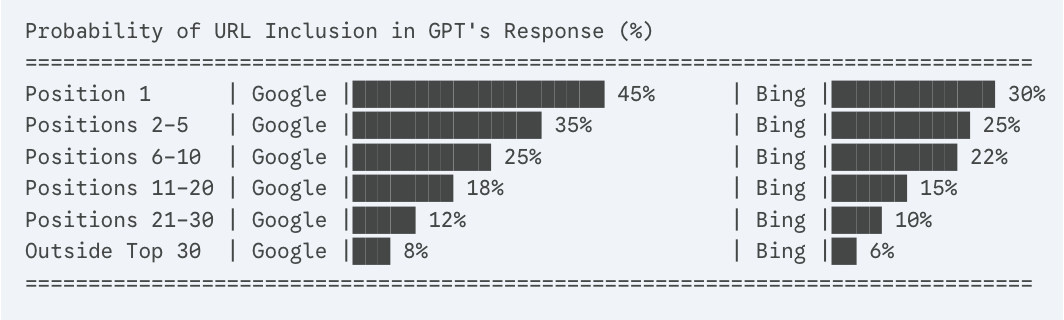
Probability of URL being included in ChatGPT response (%)
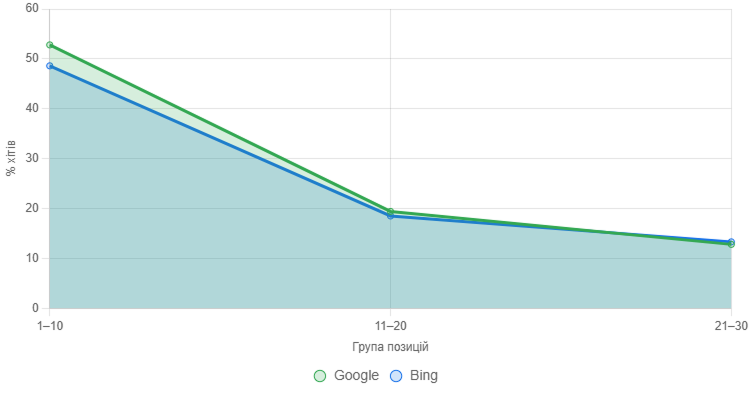
Probability of getting into ChatGPT answer by TOP-30 groups (Google vs Bing)
| Metric | Google AI | Bing AI | Comment |
|---|---|---|---|
| Hit rate from TOP-30 | 65–85% | 55–75% | Google shows higher results through broader data volume. Bing is stable but limited by search depth. For review queries (mental health, online learning) the difference is smaller: Google 80–90%, Bing 70–75% |
| Link frequency from TOP-30 | 70–90% | 60–80% | Google covers more global and local sources, increasing citation frequency. For popular topics (crypto, music) Google reaches 80–90%, for local (cafe, food delivery) — 70–75%. Bing shows 60–70% for local |
| TOP-10 | 45–65% | 48–60% | Google has higher rate through priority to authoritative sites (forbes.com, pcmag.com). Bing shows close results but stronger for aggregators (yelp.com, clutch.co) in local queries |
| TOP-11–20 | 15–25% | 15–25% | Sharp decline after TOP-10 is the same for both systems. Citation probability drops 3x compared to TOP-10 |
| TOP-21–30 | 10–20% | 10–20% | Minimal citation probability. Bing adds ~15% results in this range compared to TOP-10, Google covers more sources including Reddit/YouTube |
| TOP-1 citation probability | 30–50% | 20–35% | Google shows higher probability for first position. For popular topics (crypto) Google metric reaches 70%, for local Bing shows 60% (food delivery) |
| Probability per position (TOP-10) | 5–15% | 5–18% | Average citation probability for each position in TOP-10. Bing has slightly wider range due to variability by query types |
| TOP-21–30 probability | <10% | <10% | Minimal probability for both systems in this range |
| Logged-in accounts (from TOP-30) | 60–80% | 55–75% | Logged-in responses gravitate toward authoritative sources from TOP-30. Google shows higher personalization. Difference between them and incognito is ~15–25% |
| Incognito (from TOP-30) | 50–70% | 45–65% | Incognito expands source coverage. Google adds ~25% outside TOP-30 from internal base, Bing — ~20% through web_search |
| Internal base / web_search | 20–30% outside TOP-30 | 15–25% through web_search | Google uses internal base for local queries (NJ queries), especially for wikipedia.org, youtube.com. Bing more actively uses web_search in incognito, adding Reddit, YouTube, local sites (audimeadowlands.com) |
| Exceptions (Wikipedia, YouTube) | ~30% regardless of position | ~25% regardless of position | Authoritative sources have stable high citation probability regardless of exact position in organic search |
| Popular topics (crypto, music) | 65–80% from TOP-30 | 55–70% from TOP-30 | Google shows stronger correlation for global topics through larger data volume. Both systems focus on review articles (forbes.com, pcmag.com, coincodex.com) |
| Local queries (NJ, California) | 70–75% | 60–70% | For US local queries, Google correlates more strongly through broader source coverage. Bing actively uses aggregators (yelp.com, clutch.co). Both systems show lower dependency for geo-dependent queries without US context |
GPT demonstrates strong dependency on TOP-30 of both search engines, but Google dominates due to deeper US data coverage (65–85% vs 55–75% for Bing). The role of internal base and web_search makes dependency more flexible, allowing citation of sources outside TOP-30 (wikipedia.org, youtube.com, local sites).
Logged-in responses gravitate toward authoritative sources from TOP-30 (55–80%), incognito expands coverage to 45–70% through web_search. Popular topics (crypto, music) show 65–80% results from TOP-30 reviews, local queries with US context — 60–75% through aggregators.
Our research confirms that AI systems are not completely independent of traditional search engines. There is a clear correlation between Google/Bing positions and citation probability in ChatGPT and AI Overview, especially for TOP-10 results.
| Metric | Bing | |
|---|---|---|
| Leader in TOP-30 hit rate | Yes (75.2%) | No (65.4%) |
| Leader for reviews (forbes, pcmag) | Yes | No |
| Leader for local aggregators (yelp, clutch) | No | Yes |
| Stronger correlation | -0.94 | -0.89 |
| Uses web_search more | No | Yes (incognito) |
| Better for US queries | Yes | No |
However, the dependency is not absolute. LLMs add significant volume of their own knowledge (~20–75%) and selectively choose sources based on authority, content type, and relevance. This means SEO professionals need a hybrid strategy: achieving high organic search positions + building authority + creating content optimized for AI citation.
Citation probability drops sharply after TOP-10:
Therefore, focus on achieving TOP-10 positions for critically important queries.
Additionally, AI systems selectively choose sources, even from TOP-30. Wikipedia, major reviews (Forbes, PCMag), official sites (Binance, Coursera) have stable citation probability of 25–40% regardless of exact position. So it’s worth investing in building domain authority through quality content, E-E-A-T signals, mentions in authoritative sources.
Review articles with rankings, comparisons, “best of” lists significantly more often appear in AI responses than product or commercial pages. Therefore, create comprehensive reviews, comparisons, and guides for key topics in your niche.
Yes, it depends, but not completely. Sites from top positions (TOP-30) have higher probability of appearing in GPT responses — up to 70–90% for TOP-10. However, GPT adds ~75% content from its own knowledge base, so even sites from TOP-30 can be ignored if they don’t match the internal base.
AI Overview has strong dependency on Google TOP-30 with appearance probability of 70–80% for top positions. Average dependency is ~27% (26% Ukrainian, 24% English), but it’s selective: AI Overview chooses authoritative sources, ignoring 60–70% of other sites from TOP-30. For categorical queries (SEO, crypto, education) dependency is higher — 50–100% matches in TOP-30, especially in English results. For local queries (cafe, delivery) dependency is low or absent (0–25%) due to generalization.

CONTACTS
Promotion application: order@luxeo.team
For partnership: partner@luxeo.com.ua

Thanks for your application!
Our specialists will contact you within 24 hours