A common situation: you ask ChatGPT about the best noise-cancelling headphones and get a set of results. Will you receive the same recommendations if you repeat the query a week later? Will the model change its output? And if so — by how much?
We decided to find out. Not just once, but systematically — every week for a month, from different accounts, in incognito mode, and with a US geolocation.
10 queries — from informational to commercial:
4 account types: 2 logged-in accounts + 2 incognito sessions
Frequency: 1 check per week from each account = 4 checks per week over one month
What we tracked: sources cited in ChatGPT’s responses and how they changed week to week
How often does ChatGPT update its sources for the same query
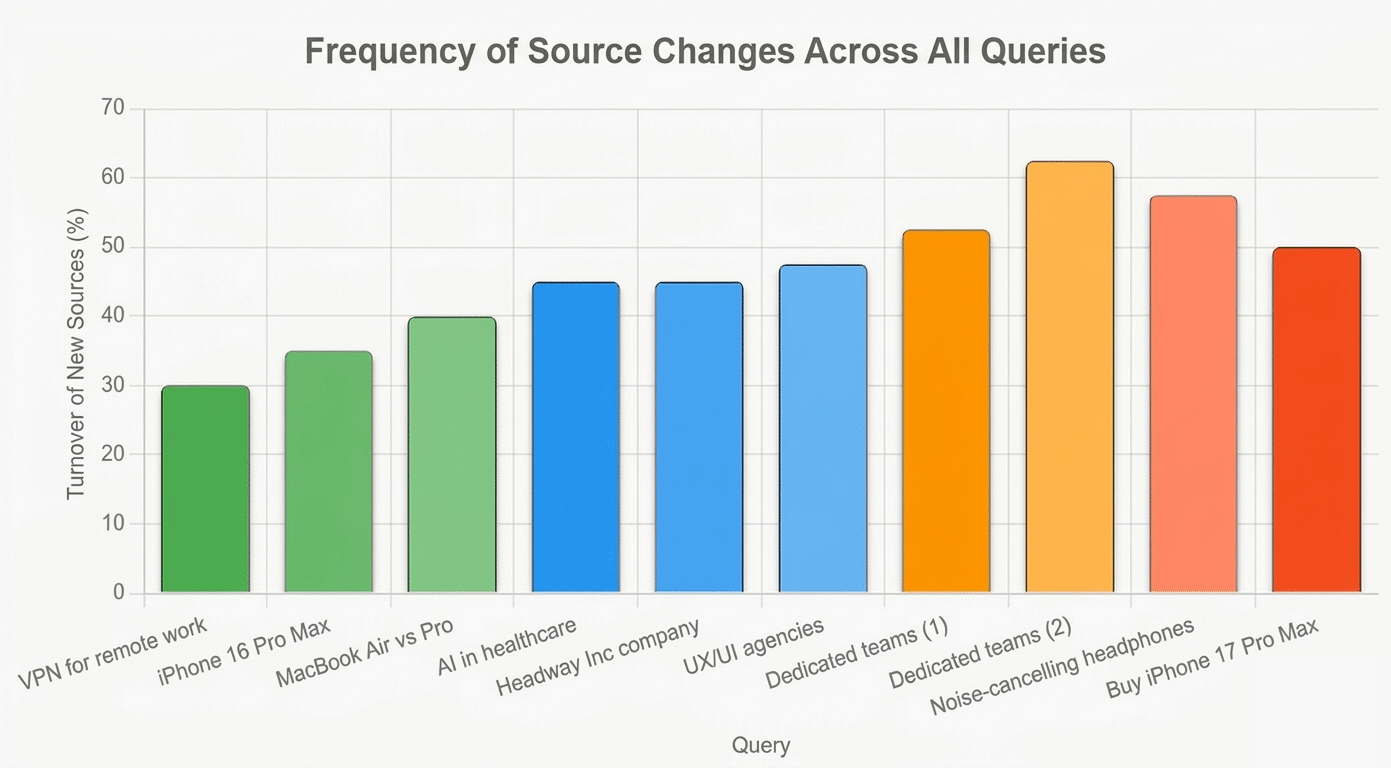
| Parameter | Observations | Conclusion |
| Rate of change | From 25% (VPN, iPhone) to 70% (dedicated teams, headphones) | The model updates its sources in proportion to how much the market changes. For stable topics (Apple products, VPN) — almost always the same sites. For commercial/service queries — a fresh selection each time. |
| Core stability | 30–70% — always authoritative sites (Apple, FDA, Tom’s Guide, TechRadar) | The model reliably maintains a “gold standard” of sources. Core conclusions can be trusted. |
| Account type / incognito impact | Minimal (5–10%) in most cases. Noticeable (15–30%) only for commercial purchases and services | A logged-in account skews slightly more official and premium. Incognito yields more niche options. The difference is not critical. |
| Overall trend | The more commercial/price-driven the query — the higher the variability. The more informational/evaluative — the more stable. | The model behaves predictably: for facts/opinions — very reliable; for purchases/services — a “fresh snapshot” each time. |
The model does not serve random sources. Nor does it repeat the exact same ones. It balances between a stable core and a shifting context.
Queries where the industry has reached a consensus:
Why so few changes? Market leaders have been fixed for years. NordVPN, ExpressVPN, ProtonVPN — their positions are stable. Reviews update rarely because the product doesn’t change radically month to month.
Most queries fall here:
Why moderate? Annual product cycles and fresh rankings, but authoritative sources (TechRadar, Tom’s Guide, FDA) remain unchanged.
Dynamic commercial markets:
Why so many changes? Prices shift, new models appear, stock changes, discounts emerge — SEO competition pushes the model to seek out the most current sources.
Regardless of query type, there is a baseline set of sources that appears again and again.
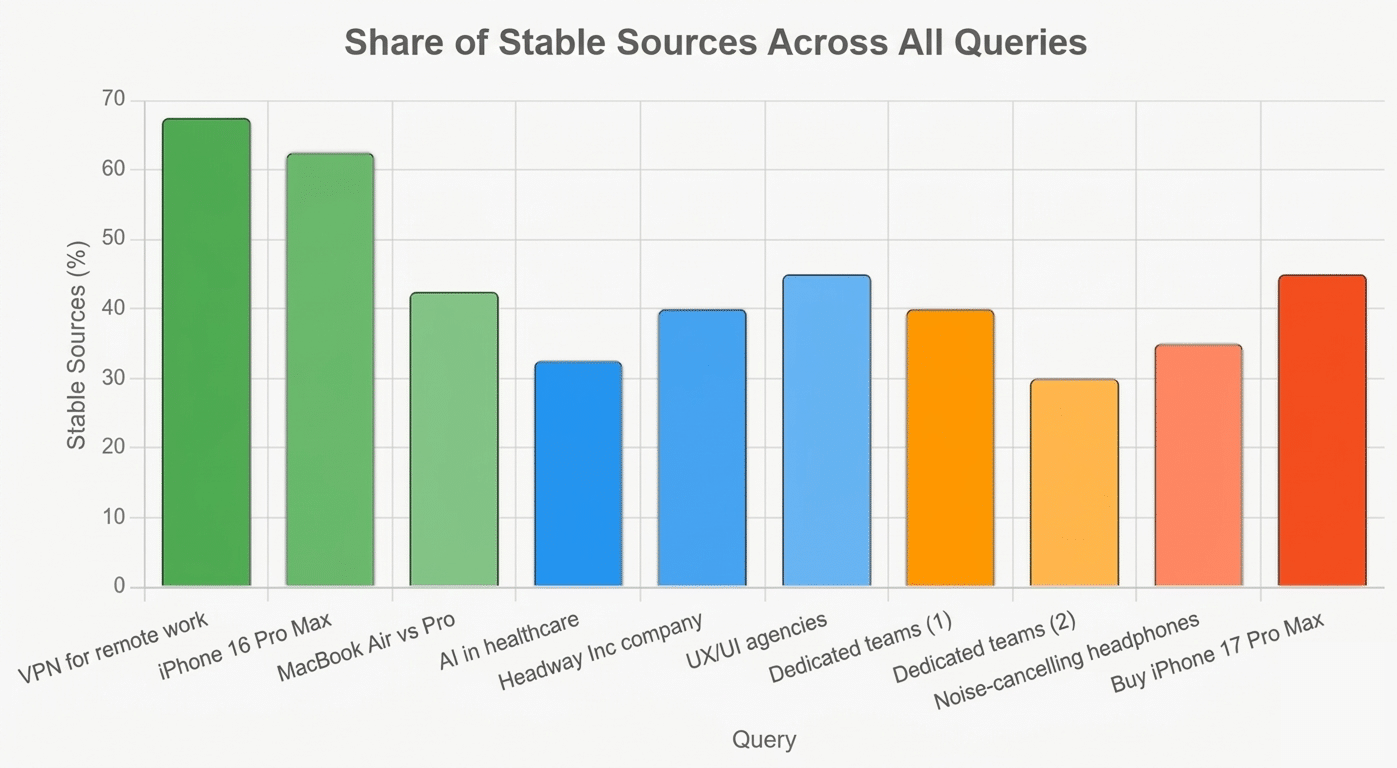
Stable sources (40–70% of responses)
These sources dominate 60–70% of responses for Apple products, regulatory questions, and top-tier reviews.
Variable sources (30–60% of responses)
Their share grows in commercial queries: headphones, dedicated team services, purchase location searches.
Average split: ~40% stable core (authoritative sources) / ~60% variable context (current/dynamic sources)
We expected to see strong personalization. In reality, the difference was minimal but noticeable.
Logged-in accounts more frequently surfaced official sites (Apple, FDA), major retailers (Amazon, BestBuy), and premium media (Tom’s Guide, TechRadar).
Incognito mode produced more niche and “gray-area” sources: lesser-known resellers, academic arXiv papers, local blogs, and specialized forums.
The difference is 5–10% in most cases, rising to 15–30% for commercial queries about purchases and services. US geolocation affects all account types equally — focus on the American market, USD, HIPAA/FDA.
1. The model seeks balance The source core (authoritative reviews, official sites, regulators) remains stable (~40–60%), while the variable portion adapts for recency — new articles, pricing, stock availability.
2. Commercial queries = maximum variability If you’re optimizing content for queries like “where to buy” or “best [product] under $200,” expect stiff competition. ChatGPT actively refreshes its sources in search of current prices and availability.
3. Informational queries = maximum stability Queries like “what do you think about” or “how to build” are the most predictable. If your brand appears in a response once, it will likely stay there for a long time — provided it carries sufficient authority.
4. Personalization is not decisive The difference between a logged-in account and incognito is only 5–10%. Personalization exists, but it is far less pronounced than in traditional Google search.
This research showed that ChatGPT’s output is neither static nor chaotic. It is a balancing system in which authority competes with recency.
Questions we are exploring next:

CONTACTS
Promotion application: order@luxeo.team
For partnership: partner@luxeo.com.ua

Thanks for your application!
Our specialists will contact you within 24 hours