Stat.vin is a service for checking and buying vehicles from Copart and IAAI auctions (USA and Canada). For each lot, the site generates a separate page with sales history, price, damage, mileage, and other VIN-based data. The site runs in multiple language versions and has millions of URLs.
At the start of the project:
The task was to identify the cause of the indexation loss, restore Googlebot crawling, and return the maximum possible number of pages to the index. In addition, the site had to be prepared for a new direction: pages for buying and shipping vehicles from the USA.
Instead of mass-submitting URLs for reindexing, we worked through the entire chain:
Discovery → Crawling → Rendering → Indexing → Internal Linking → Site Structure → Monitoring
The first step was to check whether Google actually receives the URLs Stat.vin submits for indexing. Since there was no server logging, the client set up bot data collection via Cloudflare.
Based on crawl logs, we analyzed:
This made it possible to replace assumptions with analysis of Googlebot’s actual behavior.
One of the first hypotheses was that the third-party forced indexing service was not working correctly. To test it, we ran an experiment: submitted 100 test URLs (orphan pages) to the service and checked the Cloudflare crawl logs.
Result: Googlebot visited 83 of the 100 URLs (~83%).
The mechanism for delivering URLs to Googlebot was working. The cause had to be found elsewhere: in crawl budget, site structure, URL prioritization, and the signals the site was sending to Google.
We recommended restricting crawling of such links.
We checked how Last-Modified, If-Modified-Since, and HTTP 304 Not Modified worked.
On the main part of Stat.vin, the mechanism worked correctly. In the Auto.RIA section, the Last-Modified headers and the 304 Not Modified server response did not work correctly.
The goal was to help Google determine which pages had actually changed and needed to be re-downloaded, and which ones were not worth spending crawl budget on.
Bot logs led to a hypothesis: Google actively crawls sitemaps of current vehicles and much less often those of sold vehicles. At the same time, the site was submitting a huge number of URLs with varying SEO value.
We changed the principle from “submit as many pages as possible” to “prioritize URLs with the highest value and likelihood of indexing.”
For sold-vehicle sitemaps, we proposed keeping predominantly:
In addition:
Vehicles that had just received a full VIN and a complete Stat.vin page were given separate priority.
The logic: the earlier Google receives a new Stat.vin VIN page compared to other sites, the more likely it is to be treated as the original source rather than another data duplicate.
This logic was built into the third-party indexer: vehicles fully added to the database the previous day, with a VIN and an accessible page, are automatically submitted for indexing.
We analyzed the internal linking and prepared recommendations. The goal was to give Googlebot additional paths for discovering pages and redistribute internal link equity in favor of important sections and vehicle pages.
Auction data stored the same make in different variants: Mercedes Benz, Mercedes, Mercedes-Benz. For models, there were even more variants. Thousands of make and model variants had accumulated in the database, which potentially created a large number of weak and duplicate pages.
The client developed a system for daily normalization of makes and models. After the release:
For a site with millions of URLs, even a slight degradation in server response time can significantly affect the number of pages Googlebot is able to crawl. That is why server response speed was monitored throughout the project.
In September, Google Search Console showed: increased server response time → fewer crawl requests.
We passed the issue on to the client. The development team restored lazy loading and made changes to speed up the site. After implementation, the client noted an improvement in traffic.
In parallel with indexation recovery, we worked on the link profile:
Analysis and cleanup of new spam from the profile were performed regularly.
After the technical changes, we regularly tracked:
In July, there was a period of high Google volatility in the automotive niche, during which crawling and organic traffic temporarily declined. For this reason, changes were evaluated after the search results stabilized, not within a few days.
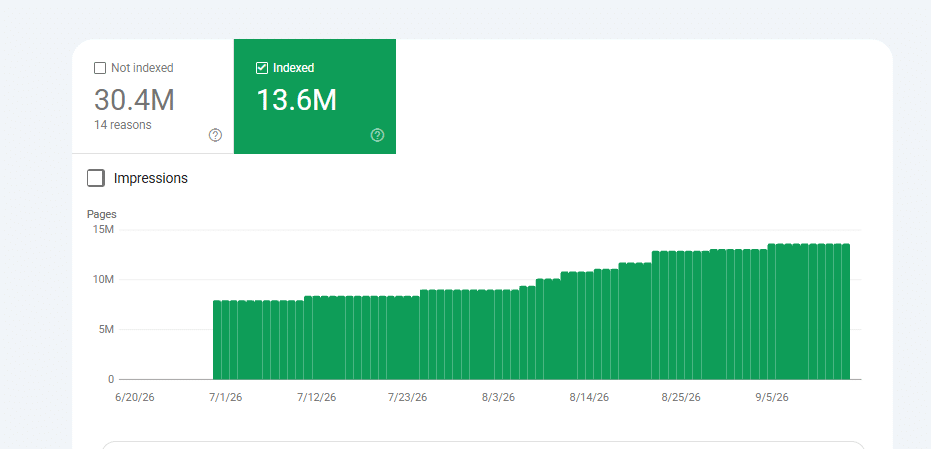
Number of pages in Google’s index:
Over the course of the work, the number of indexed pages increased by 5.7M (+72%). The July growth occurred despite a temporary significant reduction in crawl budget. At the last recorded stage, the number of indexed pages continued to grow.
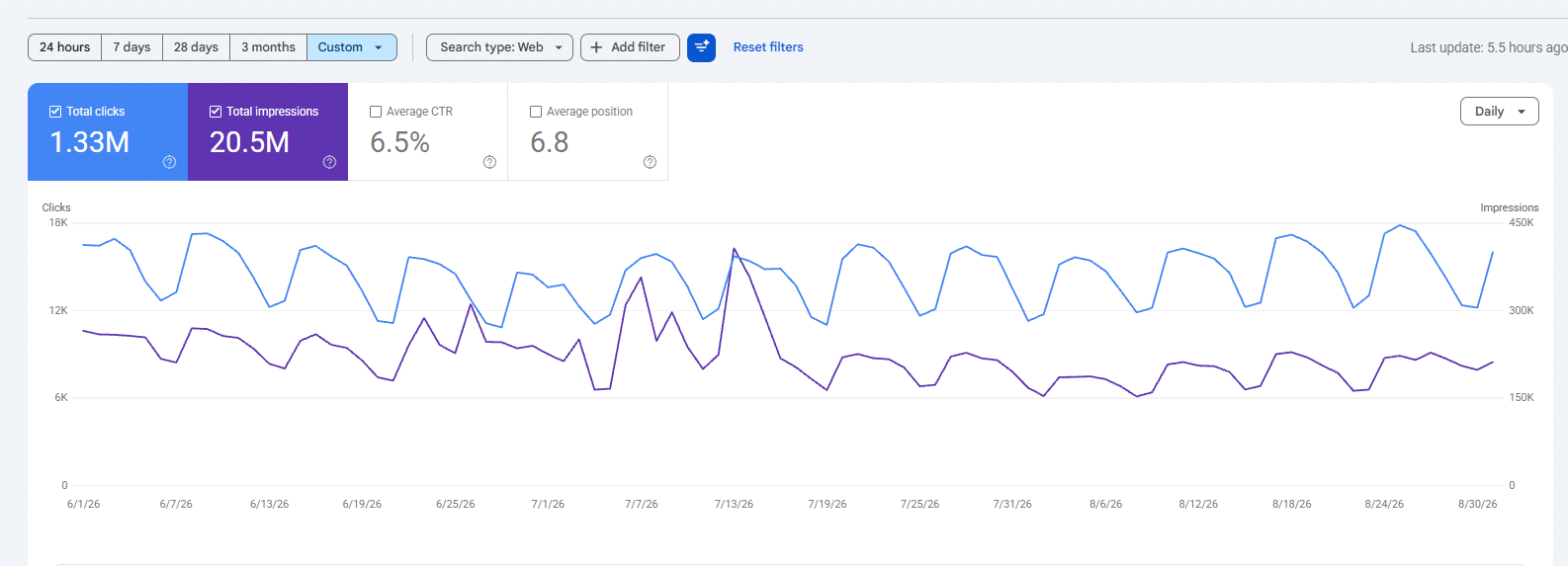
Indexation recovery did not produce an immediate linear increase in overall organic traffic: the metrics were affected by changes in search results, fluctuations in demand, and periods of volatility. After a decline in June–July, the trend turned positive in August.
Organic clicks according to Google Search Console:
Impressions for the same period (July → August): 7.22M → 6.02M.
In August, clicks grew by 4.1% compared to July, and CTR rose from 6.05% to 7.55%. The site received more clicks with fewer impressions.
On vehicle VIN pages, one of the key page types for the project, both clicks and CTR increased according to internal reports.
After the technical side stabilized, we began expanding the site’s semantic structure. We researched demand for buying and shipping vehicles from the USA and prepared:
In the first period after launch, the new shipping pages began receiving organic clicks and appearing close to the TOP for target queries.
Starting point: ≈15M pages dropped out of the index, organic traffic fell by roughly 40%.
Results:
The project moved from recovering lost indexation to expanding organic visibility in commercial areas.
For sites with millions of pages, mass-submitting URLs for reindexing is not enough. Luxeo analyzes Googlebot’s actual behavior, identifies priority URLs, and configures structure, sitemaps, and technical signals with crawl budget in mind.
If a large number of your pages have dropped out of the index, submit a request, and we will analyze your site’s indexation and propose a recovery plan.

CONTACTS
Promotion application: order@luxeo.team
For partnership: partner@luxeo.com.ua

Thanks for your application!
Our specialists will contact you within 24 hours