A personal injury attorney is a type of lawyer who represents people harmed by someone else’s negligence: in a car accident, at work, through a defective product, or by medical malpractice. The cost per click in this niche reaches $300+, which makes organic traffic a priority. Visitors make their decision quickly, relying on trust signals: attorney photos, how clear the site is, its design, awards.
Landver Law — a California law firm (Beverly Hills) specializing in personal injury cases — came to us. After discussing the client’s needs, we identified a twofold task: build and execute an SEO strategy for the main site and, in parallel, create a network of additional sites for specific cities. One team ran both efforts in parallel to keep them aligned. In this case study, we describe how we combined SEO with full-scale site development and achieved results across several directions.
| Niche | legal services, personal injury cases |
| Client | Landver Law, a law firm in Beverly Hills |
| Geography | California, full state coverage broken down by Cities and Counties |
| Goals | growing organic traffic, lead generation, coverage of target services and regions |
| Timeframe | work started in March 2026; the data in this case study is as of August 2026 (the first 6 months of cooperation) |
At the time of reaching out, the client’s site was effectively starting “from zero.” On the SEO side:
How significant the gap with competitors was is clear from a comparative analysis of organic search results:
| Metric | Client’s site (start) | Competitors in the niche |
| Domain Rating | 6 | 28–51 |
| Number of referring domains | 59 | 474–1600 |
| Total number of backlinks | 70 | 7,300–119,000 |
| Keywords in the TOP | 5 | 2,400–5,500 |
| Organic traffic | 14 | 15,600–117,700 |
Because of its YMYL classification, Google also had no reason to trust the resource. The site lacked practice area descriptions, real reviews, a block with attorney qualifications, and more. Without these signals, the search engine had no grounds to trust the site, and even technically correct pages couldn’t compete with sites that had been building up these signals for years. On top of that, page load speed was critically low.
Alongside the main domain, we ran the development of a network of 5 EMD domains (Exact Match Domain) targeting specific California cities. The client needed a team that could promote the main site while also supporting the technical development of the new infrastructure. A coordinated SEO strategy for the new domains helped avoid internal competition between the sites and repeating the main site’s mistakes.
We deliberately didn’t split the work into “SEO” and “development” — from the very start we ran both processes in parallel. The team covered the full cycle: technical audit, EMD domain development, keyword research and content strategy, competitor analysis and local SEO, link building, developing and launching the additional site network, and later GEO/AEO optimization for AI search.
The work at the first stage (research and strategy) covered five directions:
From there, we moved on to executing every point of the plan, fixing the problems identified during the audit, and implementing the strategy we had put together.
The main technical problem was structural. The site was missing the blocks that Google’s Search Quality Rater Guidelines directly link to trust: a detailed practice areas section, a block with qualifications and reviews, and a reinforced CTA with SEO copy. Without these elements, the algorithm didn’t trust the site, so any other technical work couldn’t deliver a full result in search.
We prepared a spec to rework the homepage and add new pages to the site, based on the structure used by the niche’s leaders, and, together with copywriters and developers, first updated all the most critical pages according to the spec.
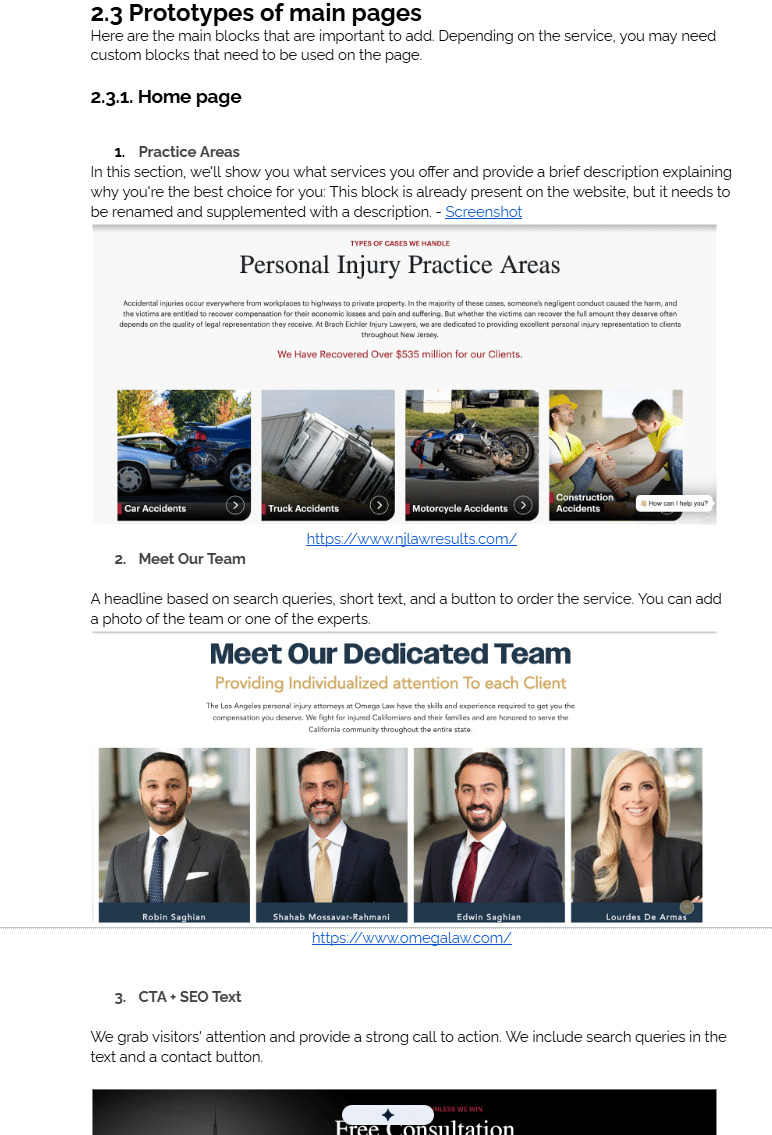
Spec for the homepage prototype
The second critical problem was load speed. A PageSpeed Insights audit showed:
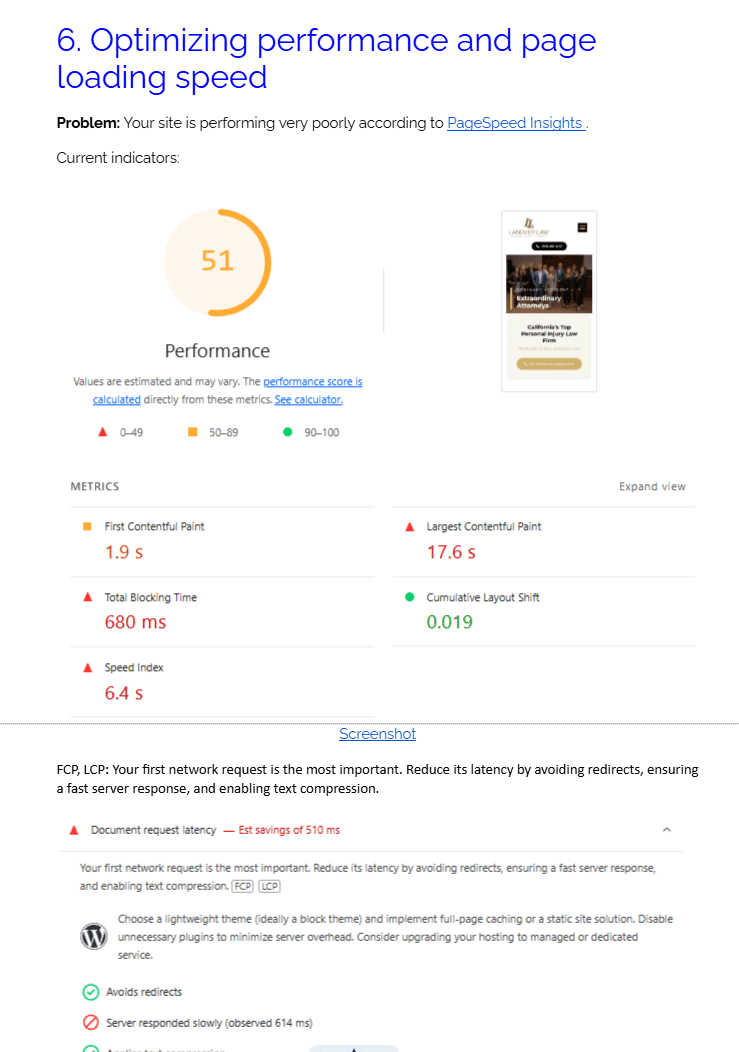
PageSpeed Insights metrics before optimization work began
We started the speed work on the mobile version of the site and finished with the desktop version. Recommendations included switching to a lighter theme, implementing full-page caching, removing unnecessary plugins, and reviewing the hosting configuration.
A separate part of the technical audit covered the site’s structured data — correct Schema.org markup for content, breadcrumbs, images, and blog articles. LegalService/Attorney markup is one of the signals search bots and AI systems use to confirm they’re looking at a legitimate legal business. We prepared a full list of the markup types needed for each page type on the site and handed it off for implementation.
California is a large state, and that had to be factored into keyword research across all the locations of interest to the client. So we included 22 cities in the scope, along with statewide queries — from Los Angeles and San Diego to less obvious directions like Temecula or Carlsbad.
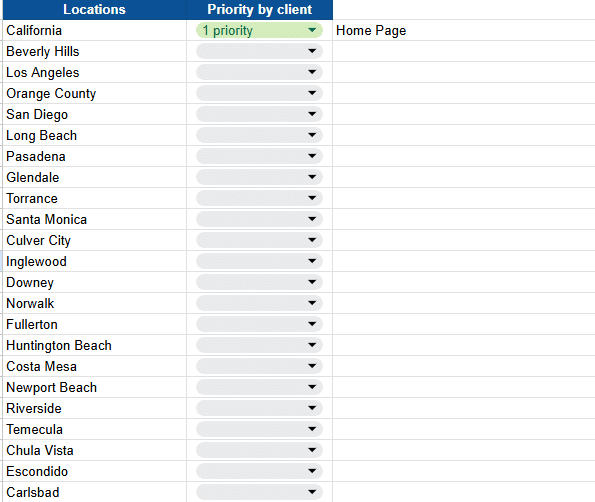
After compiling the core, we clustered the queries and broke them down by geography, so we could prioritize the work by search volume and ranking difficulty for each city and service direction separately.
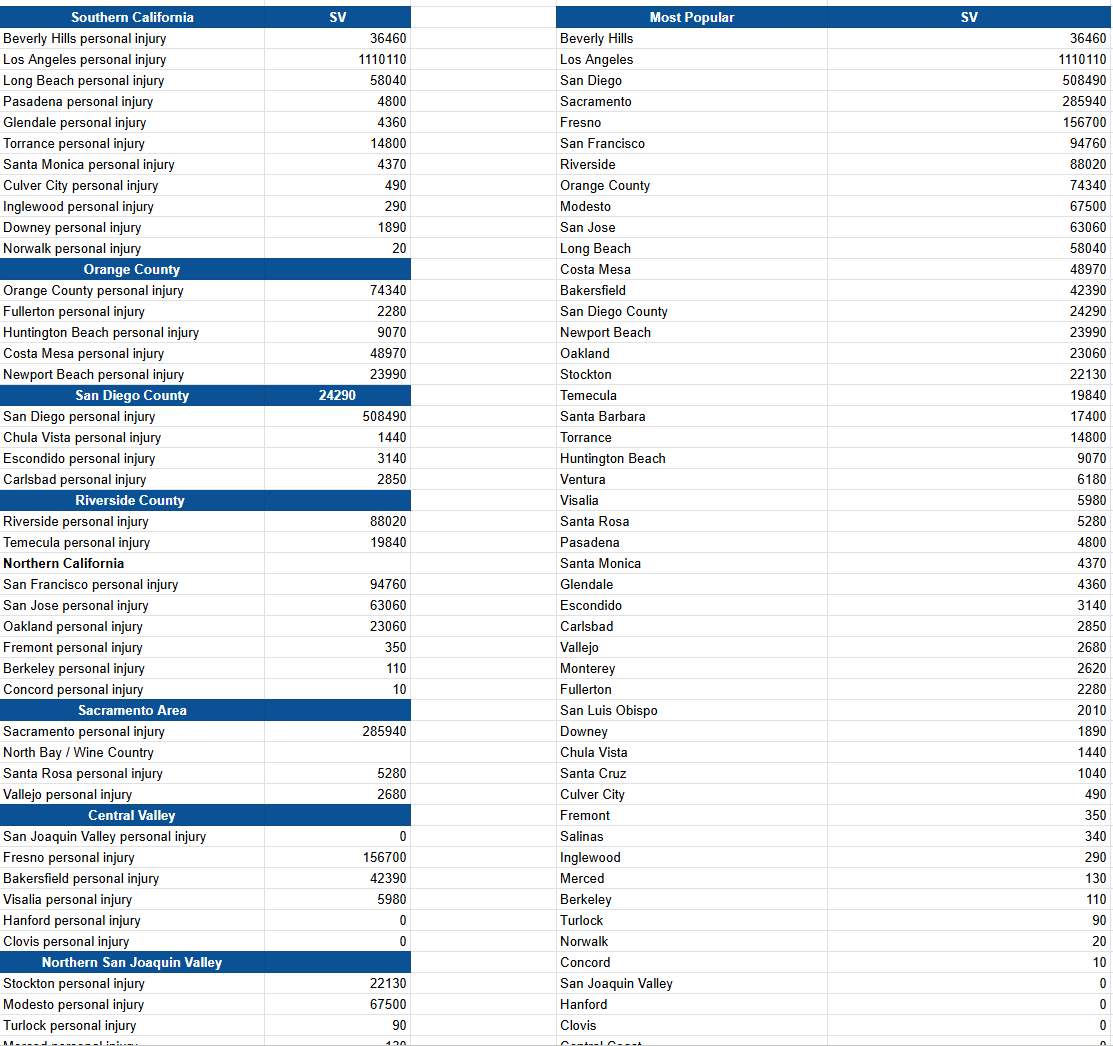
Based on the clustering, we put together content specs of two types: bulk content (standard template-based service pages) and targeted development (individual pages for high-priority clusters).
Alongside the organic analysis, we ran a separate audit of the client’s local competitors on Google My Business: we broke down their profiles, categories, reviews, and content, and used that to build a strategy for the client’s profile. We created the Google My Business profiles and completed initial optimization, followed by ongoing work.
The competitor backlink profile analysis became the basis for a separate link-building plan for the client — with a list of donor types, priority anchors, and placement formats.
The link-building strategy included:
A separate direction was optimization for generative search engines (GEO — Generative Engine Optimization): a content strategy that helps the site appear in ChatGPT Search, Google AI Overviews, and Perplexity answers. We analyzed competitors from this angle, developed a promotion strategy, and recently began the first work in this direction as part of Phase 2.
As part of this direction, we registered the client’s brand in niche, authoritative legal directories and on social networks (Avvo, Justia, FindLaw, Yelp, Google Business Profile, LinkedIn, and others) — sources AI systems use to confirm a business’s reputation. We worked on getting the brand mentioned in the materials AI pulls into its answers, including our own ranking articles on third-party platforms for queries like “Top personal injury lawyers in Beverly Hills,” and strengthened the firm’s reputation through reviews on Google, Yelp, and Avvo.
In parallel, we’re tracking whether ChatGPT mentions the client’s brand in answers to target queries, and we’ve already recorded the first instance of the client’s brand appearing in an AI-generated answer.
A separate part of the strategy was building a network of 10+ additional sites, each targeting a narrow “service + city” combination in California — an approach that closes geographic coverage gaps where promoting the main domain in each individual city is less cost-effective. The topics and locations for each site were selected based on the competitor analysis data and traffic forecast we prepared at the strategy stage. The sites themselves were built partly using AI tools.
Of the 10+ launched sites, 6 survived search engine updates and show steady positive momentum in impressions and clicks, consistently bringing the client additional leads in narrowly focused service niches.
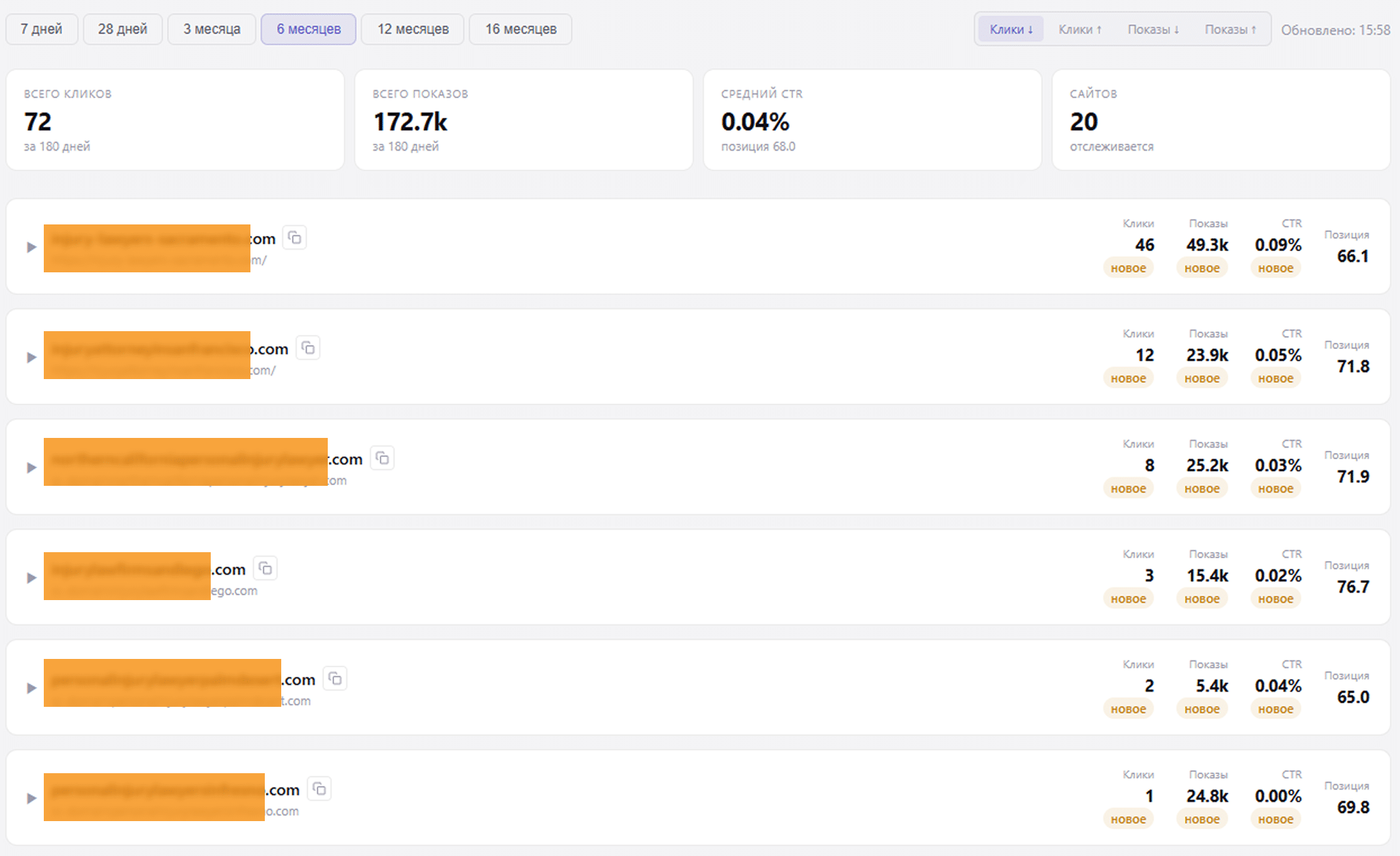
Three sites from the network are already consistently delivering new leads in the narrow service niches of the exact locations they were built for. When needed, we also quickly deploy and maintain additional infrastructure for the client’s specific business needs.
Over the first 6 months of the project, the click and impression trends in Google Search Console changed significantly:

The start of our cooperation is marked in red — after it, impressions and clicks grow
Comparing the last 6 months against the previous 6 months of work on the site:
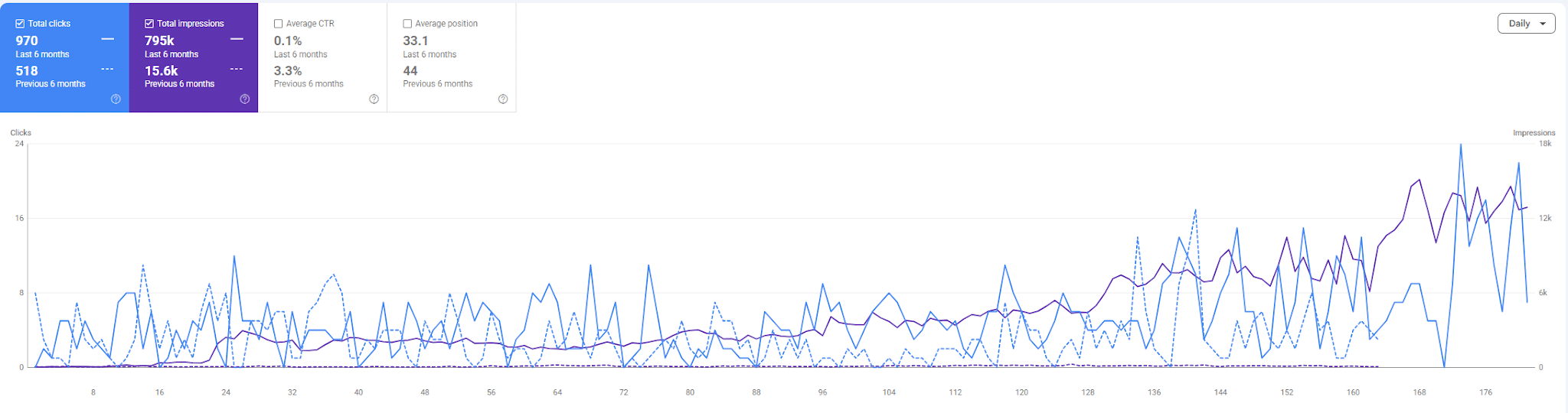
Clicks grew from 518 to 970 (almost twofold), impressions — from 15.6K to 795K (51x), average position improved from 44 to 33
The site’s average position trend in California for March–August 2026:

Site ranking growth in SeRanking, March–August 2026
The overall picture across 177 tracked keyword clusters at the end of the period:

45% of clusters are in the TOP 30, 8% are in the TOP 10, and the movement continues: 28% are still outside the TOP 100 — the next point of growth
Among the client’s most important clusters are examples of pages that didn’t exist in search results at all six months ago, now landing straight into the TOP 15–60:
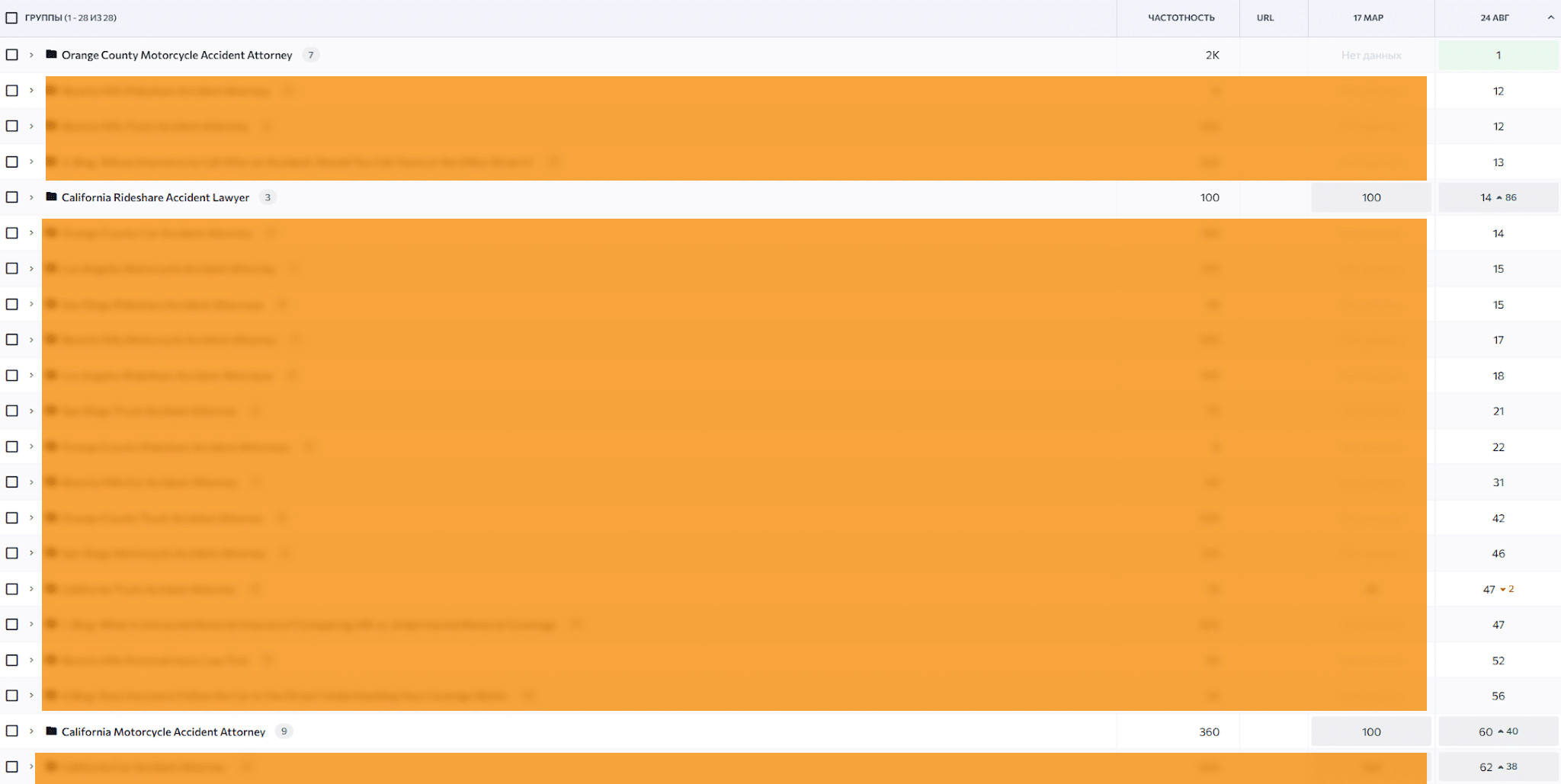
Examples: California Rideshare Accident Lawyer — from position 100 to 14; California Motorcycle Accident Attorney — from 100 to 60; Orange County Motorcycle Accident Attorney — reached position 1
It’s worth highlighting the dynamics for the city where the client’s business is located separately: over the course of the work, new keywords for Beverly Hills started ranking that had never ranked at all before.
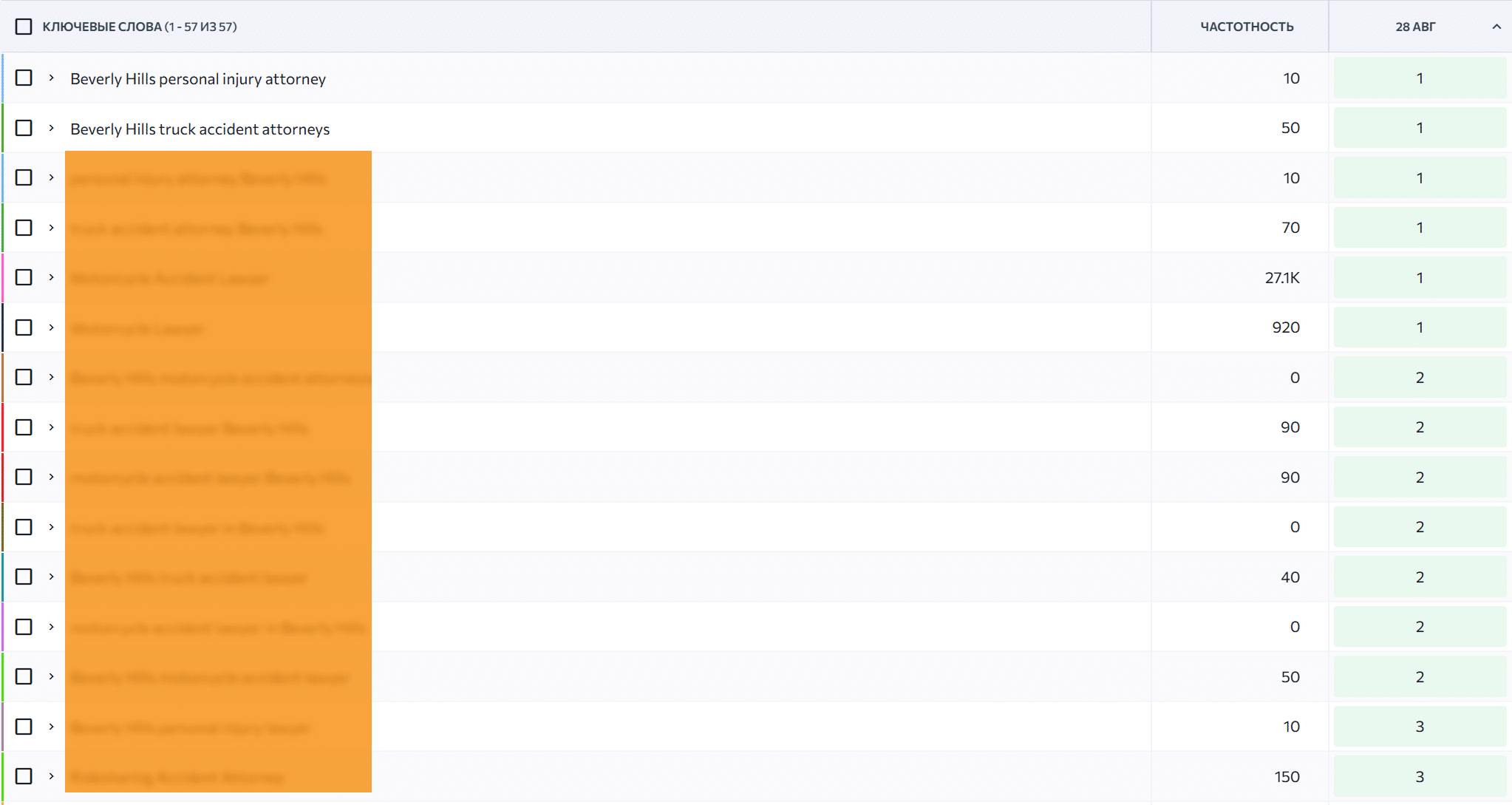
Of 57 tracked queries, a large share landed straight into the TOP 1–5
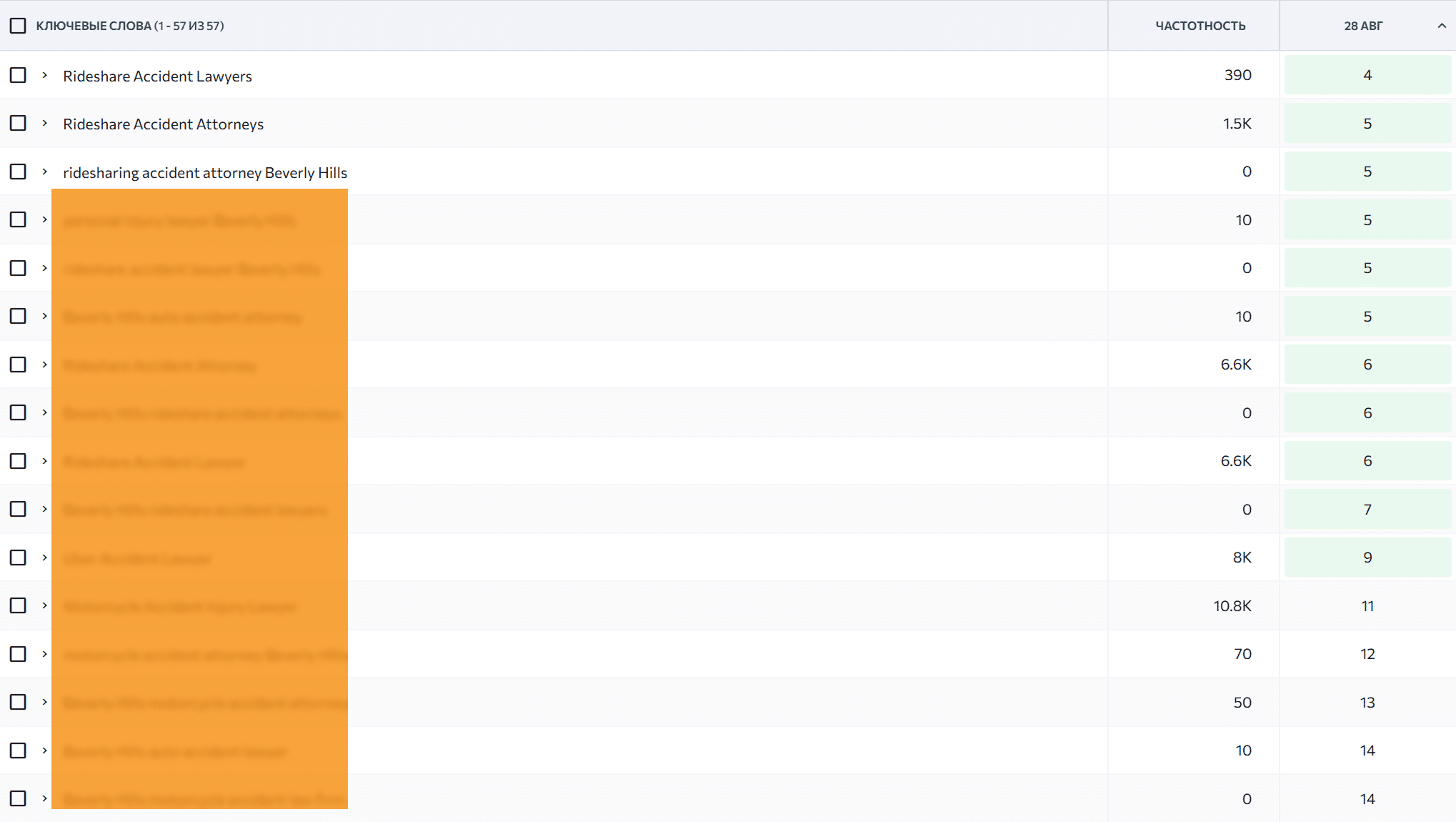
The rest of the queries settled into the TOP 5–14 — also entirely from scratch
Rankings and traffic have continued to grow throughout the entire period of work on the project. We’re currently adding low-frequency, more narrowly focused pages — to expand coverage of target services and close the “long tail” of queries, which in such a highly competitive niche often delivers the cheapest leads.
In its first six months, a project that started from zero in a highly competitive legal niche has shown steady growth.
The project required two competencies at once from the very start: promoting the existing site and developing new infrastructure for a network of additional domains. We didn’t split these tasks between different contractors. One Luxeo team ran the SEO strategy in parallel, set technical specs and oversaw development, built content and structured data to match the niche’s requirements, and also designed and launched an additional site network for specific cities.
Want similar growth in the legal niche? Leave a request on the Luxeo website to get a consultation.

CONTACTS
Promotion application: order@luxeo.team
For partnership: partner@luxeo.com.ua

Thanks for your application!
Our specialists will contact you within 24 hours