The client is a Ukrainian service for exchanging cryptocurrencies and e-money online, via a Telegram bot, and at offline branches. Its main acquisition channels are Google organic search, branded demand, and direct and referral traffic.
Internet service providers blocked the project’s main domain following a regulator’s decision.
The site remained in Google’s index, but some users could not properly access it after clicking through from search results. This degraded behavioral signals and gradually reduced search visibility.
There were two options:
The task was to move the project to a new domain, retain rankings, link equity, and organic traffic, and ensure the new domain replaced the old one in Google’s index.
Google Search Console data for May:
| Metric | Before | After | Change |
| Clicks | 7.9K | 6.1K | −23% |
| Impressions | 293K | 262K | −11% |
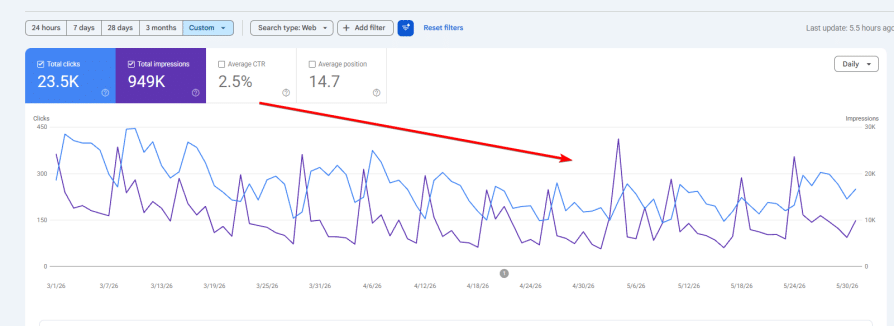
Google Search Console: clicks and impressions of the old domain
Branded traffic declined the fastest. Users searching for the service by name could not reach the site and switched to alternative services.
Meanwhile, the number of indexed pages kept growing. The problem was therefore not indexing. Google continued to crawl and rank the site, but the block cut off the user journey after the click.
1. Risk of repeated blocking. The new working domain could be blocked just like the previous one. The migration had to be designed not as a one-time move, but as infrastructure resilient to further domain changes.
2. Redirect chains. Under the standard approach, each new block adds another link:
Backlink → old domain → new domain → next domain
This creates redirect chains, dilutes link equity, and makes the link profile harder to control.
3. Link building tied to a single domain. The project had an established link profile, as well as direct and referral traffic. With the standard approach, link building would have to be moved to each new working domain every time.
4. Transition period. During a domain migration, Google recrawls URLs, processes migration signals, and reassesses relevance. Rankings fluctuate temporarily, and metrics of the old and new domains cannot be compared month over month as if they were a single site.
We built a dedicated migration infrastructure with a cloaking mechanism that works across multiple domains.
What this achieved:
The migration mechanism was launched in June.
Even before the active transfer phase, overall performance improved. For the period May 16 – June 15:
| Metric | Before | After | Change |
| Clicks | 6.37K | 7.33K | +15% |
| Impressions | 270K | 317K | +17% |
After the launch, the expected transition period began:
The decline in old domain traffic coincided with the growth of the new one: Google was redistributing visibility between the domains.
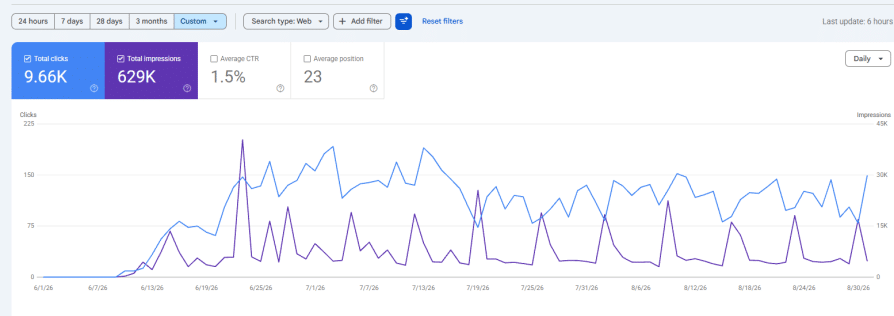
Google Search Console: clicks and impressions of the new domain after the migration launch
Success was measured not by retaining the old domain’s metrics, but by two parallel processes: the growth of the new domain and the gradual removal of the old domain from the index.
At the start of the migration, the old domain’s rankings dropped, which is expected for a domain migration. For this reason, performance was tracked by individual query clusters rather than site-wide.
By July, clusters that had completed the transfer showed ranking growth on the new domain. The transfer happened gradually, cluster by cluster.
For the week of June 22–29 (Google Ukraine, 1,018 tracked queries):
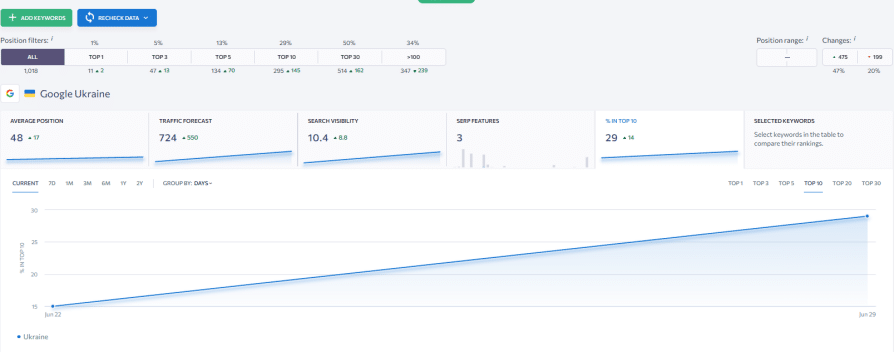
Rank tracking for the new domain in Google Ukraine
Branded traffic had been declining since the block and continued to fall in June. In the next reporting period (June 16 – July 15), the trend reversed: the new domain received 1,361 clicks from branded queries, with an upward trend. This was the first sign that the audience was returning to the service after the domain change.
According to Google Analytics, for the period June 16 – July 15, unique users from Google Organic grew from 3,276 to 3,477 (+6%) while pages were actively being transferred between domains.
| Stage | Result |
| After the block | Clicks: 7.9K → 6.1K (−23%) |
| Before the active migration phase | Clicks: 6.37K → 7.33K (+15%); Impressions: 270K → 317K (+17%) |
| After the transfer launch | Old domain traffic declines in parallel with new domain growth |
| Indexing, July | Old domain: ~14K pages in the index and still declining; new domain: growing |
| Organic users | 3,276 → 3,477 (+6%) |
Beyond recovering traffic, the project gained infrastructure that allows it to withstand the next block without losing accumulated SEO signals and without starting a new migration from scratch.
Domain blocking, rebranding, a CMS change, or a new URL structure: any move carries the risk of losing rankings and link equity. Luxeo designs SEO migrations with the specifics of each niche in mind and monitors index transfer and ranking recovery at every stage.
Submit a request if you need a migration. We will analyze your project and propose a reliable plan.

CONTACTS
Promotion application: order@luxeo.team
For partnership: partner@luxeo.com.ua

Thanks for your application!
Our specialists will contact you within 24 hours